Understanding the Russian language levels is essential for anyone who plans to study Russian seriously. Whether you want to study Russian in Moscow, take an online course, or prepare for an official language exam, knowing the structure of proficiency levels will help you plan your learning path.
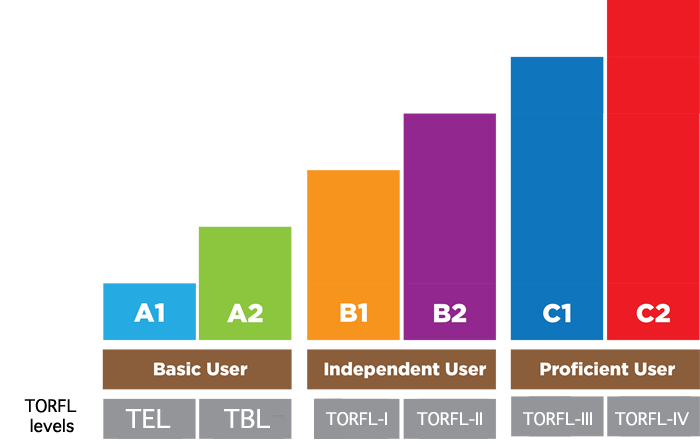
Russian proficiency levels follow the Common European Framework of Reference for Languages (CEFR). The system includes six main levels: A1, A2, B1, B2, C1 and C2. Each level represents a step in your ability to understand, speak, read and write Russian.
In Russia, these levels are also connected with the official TORFL / TRKI certification system, which is recognized internationally.
In this guide you will learn:
-
what each Russian language level means
-
what grammar and vocabulary students learn at each stage
-
how long it usually takes to progress
-
which level is required for work, study or certification
What Are Russian Language Levels?
Russian language levels describe how well a learner can use the language in real communication. Instead of simply memorizing grammar rules, the levels measure practical skills such as:
-
speaking in everyday situations
-
understanding conversations and texts
-
writing messages and formal communication
-
participating in discussions
The levels follow a clear progression:
| Level | Name | Description |
|---|---|---|
| A1 | Beginner | Basic communication |
| A2 | Elementary | Everyday survival language |
| B1 | Intermediate | Independent communication |
| B2 | Upper-Intermediate | Confident communication |
| C1 | Advanced | Professional fluency |
| C2 | Proficiency | Near-native mastery |
Many students start from A1 Beginner Russian and gradually progress toward advanced levels depending on their goals.
A1 Beginner Russian Level
The A1 level is the starting point for anyone learning Russian. At this stage students build the foundation of the language.
Students learn:
-
the Russian alphabet (Cyrillic)
-
basic pronunciation rules
-
simple grammar structures
-
essential vocabulary
Typical communication topics include:
-
introducing yourself
-
nationality and profession
-
numbers and time
-
family and friends
-
shopping and food
-
basic directions in the city
The vocabulary minimum is around 700–800 words.
Grammar topics include:
-
gender of nouns
-
present tense of verbs
-
simple sentence structure
-
basic cases
If you want to see the full curriculum and course structure, visit our detailed page for the A1 beginner course:
https://www.russian-language-school.com/a1-beginner-russian/
A2 Elementary Russian Level
The A2 level expands the ability to communicate in routine situations. Students can already handle many everyday tasks in Russian.
At this level learners can:
-
describe daily routines
-
talk about past experiences
-
ask for information
-
understand simple texts and conversations
Vocabulary grows to approximately 1,300–1,500 words.
Key grammar topics include:
-
past tense of verbs
-
basic future tense
-
accusative and prepositional cases
-
introduction to verbs of motion
Typical conversation topics include:
-
travel
-
hobbies
-
work
-
city life
-
restaurants and shopping
You can learn more about the structure of this level on the A2 Russian course page:
https://www.russian-language-school.com/a2-elementary-russian/
B1 Intermediate Russian Level
The B1 level is considered the point where students become independent users of Russian.
At this stage learners can:
-
participate in longer conversations
-
describe experiences and plans
-
express opinions
-
understand everyday media content
Vocabulary typically reaches 2,000–2,500 words.
Important grammar topics include:
-
all six Russian cases
-
verbs of motion with prefixes
-
verb aspect (perfective / imperfective)
-
complex sentences
Communication topics often include:
-
travel experiences
-
education and career
-
cultural topics
-
social situations
To see the detailed program for this stage, visit the B1 intermediate Russian course page:
https://www.russian-language-school.com/b1-intermediate-russian/
B2 Upper-Intermediate Russian Level
At B2 level, students communicate with confidence in most situations.
They can:
-
understand complex texts
-
participate in discussions
-
express arguments and opinions
-
understand films and media more easily
Vocabulary usually reaches 4,000 words or more.
Grammar becomes more advanced:
-
advanced verb aspects
-
participles and gerunds
-
complex sentence structures
-
stylistic differences
Typical discussion topics include:
-
society and culture
-
work and business
-
education systems
-
media and technology
If you plan to reach a confident level of communication, explore our B2 upper-intermediate Russian program:
https://www.russian-language-school.com/b2-upper-intermediate-russian/
C1 Advanced Russian Level
The C1 level represents advanced mastery of Russian.
At this level students can:
-
understand long and complex texts
-
speak fluently and spontaneously
-
use Russian in academic and professional settings
-
write structured essays and reports
Vocabulary often exceeds 6,000–7,000 words.
Learners master:
-
stylistic nuances
-
idiomatic expressions
-
academic vocabulary
-
advanced grammar structures
You can read more about the advanced curriculum on the C1 advanced Russian level page:
https://www.russian-language-school.com/c1-advanced-russian/
C2 Russian Proficiency Level
The C2 level represents near-native command of Russian.
Learners can:
-
understand virtually everything they hear or read
-
summarize complex information
-
express themselves precisely and naturally
-
use Russian in highly specialized contexts
C2 speakers can work as translators, researchers or language professionals.
For the full description of the highest level of mastery, visit the C2 proficiency Russian course page:
https://www.russian-language-school.com/c2-proficiency-russian/
Russian Levels and TORFL / TRKI Certification
The official Russian language exam is called TORFL (Test of Russian as a Foreign Language), also known as TRKI.
The certification system corresponds to CEFR levels:
| TORFL Level | CEFR Equivalent |
|---|---|
| TORFL Basic | A2 |
| TORFL I | B1 |
| TORFL II | B2 |
| TORFL III | C1 |
| TORFL IV | C2 |
These certificates are required for:
-
studying at Russian universities
-
working in Russia
-
official language verification
Preparing for TORFL usually requires structured training and practice with real exam tasks.
How Long Does It Take to Learn Russian?
The time required to reach each level depends on the intensity of study.
Approximate learning time:
| Level | Study Hours |
|---|---|
| A1 | 80–120 hours |
| A2 | 180–200 hours |
| B1 | 350–400 hours |
| B2 | 500–600 hours |
| C1 | 700–900 hours |
Students who take intensive Russian courses can progress faster than those studying occasionally.
Conclusion
The Russian language levels system (A1–C2) provides a clear roadmap for learners. Each level builds on the previous one and gradually develops all language skills.
Whether you want to learn Russian for travel, work, study or certification, understanding these levels will help you plan your learning journey and achieve your goals faster.